A reflection on algorithms, attention, and the things we mistakenly consider important.
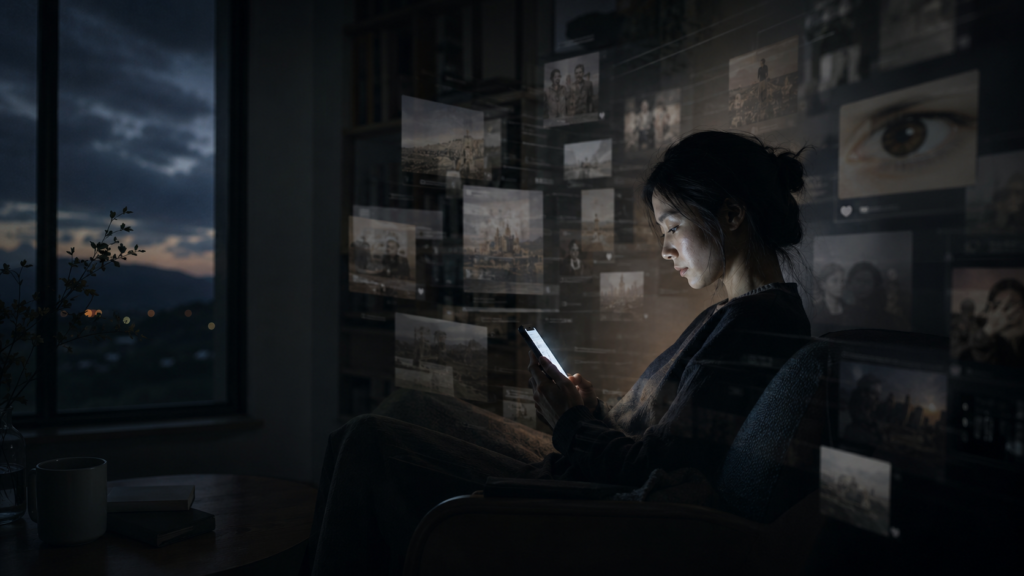
Some thoughts don’t come as thoughts.
They come as images, headlines, posts, and videos repeated enough times until they begin to feel like something I should care about.
I think about this often now.
Maybe because I grew up in a place where information did not move the way it moves today. I was born in Cuba, in a country poor, delayed, and heavily controlled in many ways. We didn’t grow up with phones in our hands. There was no endless internet with constant feeds and, no algorithms whispering the next thing into our attention.
There was an old Russian television in the house with only a few channels.
That was our window; small and limited. Which sometimes was a bit frustrating because, as kids, we wanted to see endless cartoons, good movies, or discover what was out there.
I don’t romanticize that kind of scarcity. Not having access to information can also be a prison. But it does give you a strange perspective when you live long enough to see the opposite extreme.
To go from almost nothing being available, to almost everything being available, is difficult to explain. It’s incredible and breathtaking, yet in certain aspects, it can also be dangerous.
Because it can get to you.
We now have access to an abundance of knowledge, diverse voices, visual content, varied opinions, numerous possibilities, and numerous distractions compared to any generation before us. However, amidst this vast array of information, a subtle transformation occurs.
We gradually become oblivious to the subtle ways our attention is being directed. It’s not an abrupt loss of focus, but rather a gradual shift in our perception. Our attention is subtly pulled, redirected, and guided, often without us even realizing it.We stop noticing how much of our attention is being guided.
It is funny in a sad way. We hold a device in our hands to see what is happening in the world, while the world directly in front of us keeps asking to be seen.
Sometimes all we need to do is raise our head.
But the feed is there.
Always ready.
Always offering another thing.
The feed is like a keen observer, always watching what catches our eye. It keeps tabs on our clicks, pauses, favorites, shares, frustrations, curiosities, comparisons, and how long we linger.
Then it gives us more of it.
That may sound simple, but over time, something crucial starts to fade. What initially captures our attention can gradually become indistinguishable from what truly deserves our focus.
That is where the real danger begins.
Algorithms don’t merely present us with content; they meticulously rank the world for us. They determine the order of appearance, the frequency of repetition, the perception of popularity, the sense of urgency, the perception of normalcy, the allure of desirability, and the persistence of content until it becomes deemed significant.
Everyone’s opinion starts to feel urgent.
Every trend starts to feel necessary.
Every argument starts to feel worth entering.
Every successful person can make your own life feel behind.
Every aesthetic starts to feel like identity.
Every viral thing starts to feel bigger than it really is.
And slowly, repetition begins to imitate meaning.
That line has been staying with me.
Repetition can imitate meaning.
Something doesn’t have to be profoundly true to feel genuine. It only needs to recur frequently. It just has to repeatedly present itself to us so it becomes familiar. And familiarity can begin to feel like reality.
This is not only about misinformation or politics or social media drama.
It is much closer than that. It touches how we see ourselves.
So In certain instances, I have posed these questions.
What has the internet made me compare myself to?
What did I start wanting only because I kept seeing it?
What did I start worrying about because everyone else was talking about it?
What parts of my life became smaller because the lives on my screen looked louder?
Because I have also caught myself comparing my life to people I don’t even know. I have bought things I didn’t really need. I have checked what others were doing while ignoring what needed attention in my own life.
And when I wasn’t doing well, it was worse.
Every part of my life felt smaller in comparison. Other people seemed ahead. Other artists seemed more successful. Other lives seemed better arranged. It became easy to look outward and feel behind instead of looking forward and taking the next step in front of me.
That is one of the strange effects of the feed.
It can make us feel informed while making us more restless.
It can make us feel connected while pulling us away from our own life.
It can make us feel inspired while quietly training us to compare.
As an artist, this can be particularly perilous.
You begin to observe what everyone else is doing, what style is currently trending, what garners likes, which types of tattoos are performing well, which content attracts attention, and which artists appear to be succeeding.
And if you are not careful, your own eye starts being trained by the crowd.
You begin to confuse visibility with value.
You begin to wonder if your work is enough because it is not being rewarded in the same way.
But art cannot grow only by watching what performs.
A tattoo does not become meaningful because the feed approved it. A drawing does not become better because it fits the trend of the month. A voice does not become more honest because it was shaped to be liked by strangers.
There is a difference between learning from the world and being shaped by its noise.
The hard part is knowing when one becomes the other.
I don’t want to make algorithms sound like some evil creature lurking behind every screen. They are not magical or supernatural. They are simply systems; a set of instructions that enable machines to make decisions about what to display next.
They are also useful in many ways.
They help us find music, books, directions, articles, tools, communities, and ideas we may never have discovered on our own. They help organize a world with too much information for one person to sort through alone.
But the same thing that helps us can also shape us.
A recommendation system is not asking:
What will make this person wiser?
What will help this person live better?
What does this person truly need?
Most of the time, it is asking something much simpler:
What will keep them here?
That question changes everything.
Because what keeps us engaged is not always what nourishes us.
Outrage keeps us engaged.
Fear keeps us engaged.
Desire keeps us engaged.
Comparison keeps us engaged.
Validation keeps us engaged.
Arguments keep us engaged.
Beauty keeps us engaged.
Drama keeps us engaged.
And once the system learns what holds us, it gives us more of it.
Not because it hates us.
Not because it knows us in a human way.
But because that is what it is built to do.
Over time, the feed can slowly form what we admire, what we fear, what we compare ourselves to, what we think success looks like, what we think beauty looks like, and what we think a life should look like.
That is the deeper problem.
Not distraction.
Formation.
The danger is not that the algorithm controls us like machines. The danger is softer than that. It keeps placing mirrors in front of us until we forget which reflection was ours.
A version of us begins to appear on the screen.
A profile made from our pauses, clicks, searches, likes, and habits.
Then the feed gives that version more of what it already wants.
And slowly, if we are not awake, we begin to become the person the feed has been feeding.
That is a strange thought.
We think we are exploring.
But often we are being returned to ourselves in a narrower form.
More of the same interests.
More of the same opinions.
More of the same fears.
More of the same desires.
More of the same anger.
More of the same identity.
And after a while, the world can start to feel smaller while we believe we are seeing more of it.
That may be one of the most subtle illusions of our time.
We have access to almost everything, but we are often shown more of what already keeps us looking.
This is why different people can live in completely different realities while holding the same device in their hands.
One person opens their phone and sees outrage.
Another sees beauty standards.
Another sees money.
Another sees politics.
Another sees fitness.
Another sees fear.
Another sees luxury.
Another sees failure.
Another sees proof that everyone agrees with them.
The feed becomes a room.
And after sitting in that room long enough, we start to forget that there are other rooms.
This matters because attention is not neutral.
What we repeatedly see changes what we notice.
What we notice changes what we think about.
What we think about changes what we care about.
And what we care about eventually shapes how we live.
That is why I keep returning to the same question:
How much of what I think matters actually came from me?
And how much was placed in front of me until I accepted it as important?
This is not an easy question to answer.
Because the feed does not always feel like manipulation. Most of the time it feels normal. Smooth. Convenient. Entertaining.
It comes through people we follow. Brands we like. Artists we admire. Friends. News. Jokes. Advice and even as an Inspiration.
It feels like culture.
It feels like life.
It feels like what everyone is talking about.
But sometimes what “everyone” is talking about is simply what the system has decided to make visible.
And visibility has power.
What is seen more often feels larger.
What is repeated starts to feel like true.
What is rewarded feels valuable.
What is ignored starts to feel unimportant, even when it may be the thing we need most.
Quiet work is rarely rewarded immediately.
Patience is not always entertaining.
Depth does not always perform.
Healing is not always visible.
Character does not go viral every day.
A real life is often too slow for the feed.
But that does not make it less valuable.
Sometimes the most important things in life are not loud enough to compete for our attention.
Health.
Presence.
A conversation.
Rest.
Craft.
Faith.
Family.
A walk.
A book.
A quiet hour.
The work no one sees.
The decision not to react.
The discipline to return to something that matters.
These things may not pull at us aggressively. They may not flash. They may not trend. They may not demand to be seen.
But they shape us, quietly and deeply overtime
Maybe that is why we have to become more protective of our attention.
Not paranoid or dramatic, not against technology.
Just awake.
Maybe the first act of freedom is noticing what has been asking for our attention.
Before reacting, we can pause.
Before sharing, we can ask if something is actually true, or just emotionally loud.
Before comparing, we can remember that we are seeing a fragment, not a whole life.
Before wanting, we can ask if the desire is ours, or if it was planted by repetition.
Before entering another argument, we can ask if it deserves a piece of our day.
We cannot control every image that enters the mind.
But we can become more careful with what we keep returning to.
That may be where choice begins again.
Not in rejecting the modern world.
But in refusing to let the feed become the only world we know.
The algorithm can show us many things.
It can suggest.
It can repeat.
It can rank.
It can tempt.
It can reflect back a version of ourselves.
But it should not become the final teacher of what matters.
Maybe the question is not only what the feed shows us.
Maybe the question is what it is teaching us to care about.
And whether we still know the difference.